
USCG Engine Plants (Supplementary)
Module Code: USCG PLANTS-SUPP • 275 verified questions across 10 practice sets with 46 CFR and engineering rule citations. Completely free with zero paywalls.
USCG Engine Plants (Supplementary) Practice Sets
Select any module set below to begin timed examination practice with full answer analysis.
USCG PLANTS-SUPP Practice Set 1
Full questions with verified 46 CFR rule explanations.
USCG PLANTS-SUPP Practice Set 2
Full questions with verified 46 CFR rule explanations.
USCG PLANTS-SUPP Practice Set 3
Full questions with verified 46 CFR rule explanations.
USCG PLANTS-SUPP Practice Set 4
Full questions with verified 46 CFR rule explanations.
USCG PLANTS-SUPP Practice Set 5
Full questions with verified 46 CFR rule explanations.
USCG PLANTS-SUPP Practice Set 6
Full questions with verified 46 CFR rule explanations.
USCG PLANTS-SUPP Practice Set 7
Full questions with verified 46 CFR rule explanations.
USCG PLANTS-SUPP Practice Set 8
Full questions with verified 46 CFR rule explanations.
USCG PLANTS-SUPP Practice Set 9
Full questions with verified 46 CFR rule explanations.
USCG PLANTS-SUPP Practice Set 10
Full questions with verified 46 CFR rule explanations.
Sample USCG Engine Plants (Supplementary) Questions & Solutions
Preview authentic USCG NMC exam questions from this module with verified answers and rule citations.
The wooden shoring shown in the illustration is bearing against the hatch coaming and is supporting a load in the direction indicated by the arrows. Which of the following statements is correct for the this condition? SF-0018
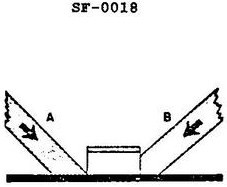 Illustration SF-0018
 Proper shoring requires the shore to be installed perpendicular to the load-bearing surface to maximize compressive strength. Shore B is positioned correctly to distribute the force evenly across the timber's cross-section, preventing the buckling or splitting that occurs when a shore is installed at an inefficient, non-perpendicular angle.
Which of the methods shown in the illustration is the correct way to fit shoring? SF-0016
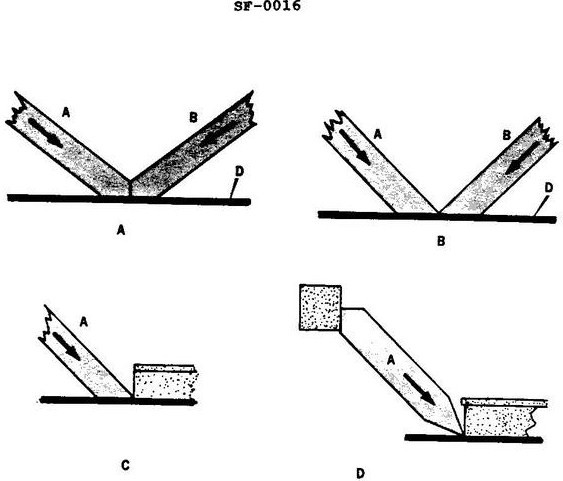 Illustration SF-0016
 Effective shoring relies on the principle of direct load transfer. Method A demonstrates the correct practice of using a wedge and a sole piece to ensure the shore is tight and properly aligned with the structural member, minimizing the risk of slippage or structural failure under heavy load.
After an emergency shoring installation has been completed, the __________.
Emergency shoring is subject to constant vibration and structural movement from sea states. Frequent inspections are mandatory to ensure that wedges remain tight and the shoring has not shifted, maintaining the integrity of the temporary repair until permanent structural restoration can be performed in a shipyard environment.
The lengthening of a crack formed in the shell plating of a ship may be prevented by __________.
Drilling a hole at the terminus of a crack, known as 'stop-drilling,' effectively redistributes the stress concentration away from the sharp crack tip. This prevents further propagation of the fracture through the shell plating, providing a temporary mechanical solution to maintain hull integrity until permanent welding repairs are completed.
A hole in the hull above the waterline may be temporarily patched with __________.
Temporary hull patches above the waterline utilize soft materials like blankets, pillows, or mattresses to conform to the irregular shape of the damaged plating. These items are compressed against the breach to minimize air intake or water ingress, serving as an immediate, improvised damage control measure until permanent repairs occur.
For a victim who is coughing and gagging, as a result of a partial obstruction of the airway by a foreign body, a potential rescuer should __________.
If a victim is coughing and gagging, the airway is only partially obstructed. Forcing abdominal thrusts prematurely can cause the object to lodge deeper or cause injury. The priority is to encourage the victim to cough forcefully to expel the obstruction naturally while monitoring for complete airway blockage requiring intervention.
Explore Other USCG Exam Modules
Complete your Coast Guard examination preparations across all 25 Deck, Engineering, and Radio ratings:
Frequently Asked Questions
Common questions regarding the USCG Engine Plants (Supplementary) examination, scoring benchmarks, and study strategies.
What is the USCG Engine Plants (Supplementary) examination?
What is the passing score for USCG PLANTS-SUPP?
How many questions are in the USCG USCG PLANTS-SUPP question bank on Bright Mariner?
Is access to the USCG PLANTS-SUPP practice questions completely free?
Are these questions up to date with current 46 CFR and USCG NMC standards?
Question Discussion & Notes
0Have a doubt, memory trick, or exam update? Share your insights with fellow mariners.