
USCG Rules of the Road Questions and Answers
Prepare for your National Maritime Center (NMC) Deck licensing examination with our comprehensive database of 1,025 verified USCG Rules of the Road questions and answers. Take free interactive online practice tests or download our print-ready USCG Rules of the Road practice test PDF to master the mandatory 90% passing benchmark.
USCG Rules of the Road Practice Test PDF (Free Download)
Download our curated 30-question printable USCG Rules of the Road practice test PDF complete with verified answer keys and 46 CFR / COLREGS explanations. Optimized for offline study, classroom review, or boat-deck reference without internet access.
- ✓ 30 Curated NMC Exam Questions
- ✓ Full Answer Key & Rule Citations
- ✓ Formatted for 8.5" x 11" Letter Printing
- ✓ 100% Free • Direct Download (71 KB)
USCG Rules of the Road Practice Test: Choose a Set
Simulate official NMC exam sessions with 35 timed 30-question interactive practice sets.
Rules of the Road Set 1
Full questions with verified 46 CFR rule explanations.
Rules of the Road Set 2
Full questions with verified 46 CFR rule explanations.
Rules of the Road Set 3
Full questions with verified 46 CFR rule explanations.
Rules of the Road Set 4
Full questions with verified 46 CFR rule explanations.
Rules of the Road Set 5
Full questions with verified 46 CFR rule explanations.
Rules of the Road Set 6
Full questions with verified 46 CFR rule explanations.
Rules of the Road Set 7
Full questions with verified 46 CFR rule explanations.
Rules of the Road Set 8
Full questions with verified 46 CFR rule explanations.
Rules of the Road Set 9
Full questions with verified 46 CFR rule explanations.
Rules of the Road Set 10
Full questions with verified 46 CFR rule explanations.
Rules of the Road Set 11
Full questions with verified 46 CFR rule explanations.
Rules of the Road Set 12
Full questions with verified 46 CFR rule explanations.
Rules of the Road Set 13
Full questions with verified 46 CFR rule explanations.
Rules of the Road Set 14
Full questions with verified 46 CFR rule explanations.
Rules of the Road Set 15
Full questions with verified 46 CFR rule explanations.
Rules of the Road Set 16
Full questions with verified 46 CFR rule explanations.
Rules of the Road Set 17
Full questions with verified 46 CFR rule explanations.
Rules of the Road Set 18
Full questions with verified 46 CFR rule explanations.
Rules of the Road Set 19
Full questions with verified 46 CFR rule explanations.
Rules of the Road Set 20
Full questions with verified 46 CFR rule explanations.
Rules of the Road Set 21
Full questions with verified 46 CFR rule explanations.
Rules of the Road Set 22
Full questions with verified 46 CFR rule explanations.
Rules of the Road Set 23
Full questions with verified 46 CFR rule explanations.
Rules of the Road Set 24
Full questions with verified 46 CFR rule explanations.
Rules of the Road Set 25
Full questions with verified 46 CFR rule explanations.
Rules of the Road Set 26
Full questions with verified 46 CFR rule explanations.
Rules of the Road Set 27
Full questions with verified 46 CFR rule explanations.
Rules of the Road Set 28
Full questions with verified 46 CFR rule explanations.
Rules of the Road Set 29
Full questions with verified 46 CFR rule explanations.
Rules of the Road Set 30
Full questions with verified 46 CFR rule explanations.
Rules of the Road Set 31
Full questions with verified 46 CFR rule explanations.
Rules of the Road Set 32
Full questions with verified 46 CFR rule explanations.
Rules of the Road Set 33
Full questions with verified 46 CFR rule explanations.
Rules of the Road Set 34
Full questions with verified 46 CFR rule explanations.
Rules of the Road Set 35
Full questions with verified 46 CFR rule explanations.
Sample USCG Rules of the Road Questions & Solutions
Preview authentic USCG NMC exam questions from this module with verified answers and rule citations.
BOTH INTERNATIONAL & INLAND A vessel displaying the lights shown in illustration D063RR below is which of the following?
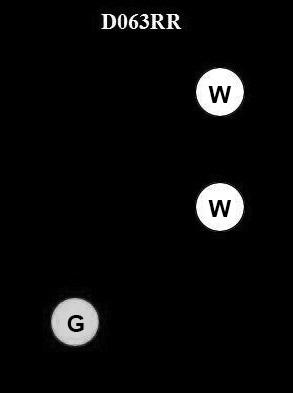 Illustration D063RR
 Rule 24(a) mandates that a power-driven vessel towing astern must display two masthead lights in a vertical line. If the length of the tow exceeds 200 meters, three masthead lights are required. The presence of these vertical masthead lights, combined with sidelights and a stern light, identifies a vessel engaged in towing.
BOTH INTERNATIONAL & INLAND What is the minimum vessel length which must show two white masthead lights, one forward and one aft, when underway at night?
Under Inland Navigation Rules, for the condition where 'What is the minimum vessel length which must show two white masthead lights, one forward and one aft, when underway at night', the correct requirement is: '50 meters'. This standard ensures clear navigational intent and collision avoidance.
BOTH INTERNATIONAL & INLAND You are on vessel "A" as shown in illustration D032RR below, and hear vessel "B" sound a signal indicating her intention to overtake you. You feel it is not safe for vessel "B" to overtake you at the present time. What action should you take?
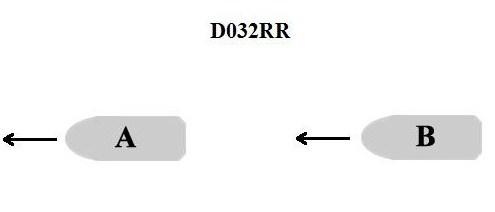 Illustration D032RR
 Rule 34(d) (Inland) and Rule 34(d) (International) require a vessel being overtaken to sound the danger signal—five or more short, rapid blasts—if she fails to understand the intentions of the overtaking vessel or is in doubt whether sufficient action is being taken by the overtaking vessel to avoid collision.
BOTH INTERNATIONAL & INLAND Which vessel would have no white lights visible when meeting her head-on?
Under Inland Navigation Rules, for the condition where 'Which vessel would have no white lights visible when meeting her head-on', the correct requirement is: 'A vessel not under command'. This standard ensures clear navigational intent and collision avoidance.
BOTH INTERNATIONAL & INLAND For identification purposes at night, U.S. Navy submarines on the surface may display an intermittent flashing light of which color?
Rule 1(d) allows for special rules made by the government for ships of war. Under 33 CFR 83.01(d), U.S. Navy submarines are authorized to display an intermittent flashing amber (yellow) beacon for identification purposes when operating on the surface, as this light is not otherwise used for standard navigation lights.
BOTH INTERNATIONAL & INLAND Which is a light signal authorized by the Secretary of the Navy as an additional navigational light for a ship of war?
Rule 1(c) permits special station or signal lights for warships. Under these provisions, the Secretary of the Navy has authorized an intermittent flashing amber (yellow) beacon as an additional navigational light to identify submarines operating on the surface, enhancing safety due to their low profile.
USCG Rules of the Road Exam Breakdown & Syllabus
The USCG Rules of the Road examination tests your ability to make split-second, legally sound navigation decisions. Questions cover the Navigation Rules and Regulations Handbook (COMDTINST M16672.2D / USCG Navigation Center) divided into 5 core parts and 5 technical annexes:
General, Steering & Sailing Rules (Rules 1–19)
The most heavily tested portion of the exam. Covers Rule 2 (General Prudential Rule / Responsibility), Rule 5 (Look-out), Rule 6 (Safe Speed), Rule 7 (Risk of Collision), and Rule 8 (Action to Avoid Collision).
- Rule 9 & 10: Narrow channels and Traffic Separation Schemes (TSS).
- Rules 11–18: Head-on (Rule 14), Crossing (Rule 15), Overtaking (Rule 13), Give-way (Rule 16), and Stand-on (Rule 17) duties.
- Rule 18 Hierarchy: Order of precedence for NUC, RAM, CBD, Fishing, Sailing, and Power-driven vessels.
- Rule 19: Conduct of vessels in restricted visibility (fog), radar plotting, and early evasive action.
Lights, Shapes, Sound & Light Signals (Rules 20–37)
Memorization of visual and acoustic signals is vital. Questions present situational diagrams asking you to identify vessel type, aspect, and operating status.
- Rules 20–31: Arcs of visibility (Masthead 225°, Sidelights 112.5°, Sternlight 135°, All-round 360°), towing/pushing configurations, dredge operations, and day shapes (balls, diamonds, cones).
- Rule 34: Maneuvering & warning signals (1 short blast: altering starboard; 2 short blasts: altering port; 5 short blasts: danger signal).
- Rule 35: Sound signals in restricted visibility (power-driven underway making way, making no way, vessels restricted in maneuverability).
- Rule 37 / Annex IV: Official international and inland distress signals.
International COLREGS vs. US Inland Rules: Critical Exam Distinctions
Coast Guard examiners intentionally include distinction questions. Keep this quick reference in mind:
| Rule Subject | International Rules (COLREGS 1972) | US Inland Rules (33 CFR 83) |
|---|---|---|
| Whistle Maneuvering Signals (Rule 34) | Signals of action taken: 1 short blast = "I am altering course to starboard." | Signals of intent/proposal: 1 short blast = "I intend to leave you on my port side." Requires agreement before altering course. |
| Towing Lights (Rule 24) | Yellow towing light placed vertically above the white sternlight. | Two yellow towing lights in vertical line for pushing ahead or towing alongside on Western Rivers. |
| Narrow Channels & Western Rivers (Rule 9/14) | No distinction between upbound and downbound vessels. | Downbound vessel with following current has right-of-way over upbound vessel and indicates passing side. |
| Vessels Constrained by Draft (Rule 28) | Recognized with day shape (cylinder) and lights (3 red lights vertically). | Not recognized in US Inland Rules. No lights or day shapes prescribed. |
| Special Distress Signal (Annex IV) | Standard flares, orange smoke, SOS, continuous fog horn. | Includes high-intensity white light flashing 50–70 times/min (strobe light). |
Exam Strategy: How to Pass the 90% USCG ROR Benchmark
Remember N-R-C-F-S-P: Not Under Command > Restricted in Ability to Maneuver > Constrained by Draft > Fishing > Sailing > Power-Driven. A vessel higher on the list is stand-on to lower vessels under Rule 18.
Under Rule 15, if another vessel approaches on your starboard side, you are the Give-Way vessel and must take early, substantial action to pass astern. If on your port side, you are Stand-On under Rule 17.
Always scan the very first words of the question prompt. A question marked INLAND ONLY or INTERNATIONAL ONLY requires applying that specific rule set rather than default assumptions.
Explore Other USCG Exam Modules
Complete your Coast Guard examination preparations across all 25 Deck, Engineering, and Radio ratings:
Frequently Asked Questions
Common questions regarding the USCG Rules of the Road examination, scoring benchmarks, and study strategies.
What is the USCG Rules of the Road examination?
What is the passing score for the USCG Rules of the Road exam?
Where can I download the USCG Rules of the Road practice test PDF?
How many questions and practice sets are in the BrightMariner USCG ROR question bank?
What are the most crucial differences between International COLREGS and US Inland Rules?
How can I study to score 90%+ on the USCG Rules of the Road practice test?
N-R-C-F-S-P (Not Under Command > Restricted in Ability to Maneuver > Constrained by Draft > Fishing > Sailing > Power-Driven); 2) Thoroughly study Rule 19 for restricted visibility actions and radar plotting; 3) Master day shapes, light arcs (Masthead 225°, Sidelights 112.5°, Sternlight 135°), and whistle signals; 4) Always check whether a question begins with 'INLAND ONLY' or 'INTERNATIONAL ONLY'; and 5) Complete all interactive practice tests on BrightMariner until consistently scoring 28/30 or higher.Question Discussion & Notes
0Have a doubt, memory trick, or exam update? Share your insights with fellow mariners.