
USCG Gas Turbines
Module Code: USCG GAS-TURB • 277 verified questions across 10 practice sets with 46 CFR and engineering rule citations. Completely free with zero paywalls.
USCG Gas Turbines Practice Sets
Select any module set below to begin timed examination practice with full answer analysis.
USCG GAS-TURB Practice Set 1
Full questions with verified 46 CFR rule explanations.
USCG GAS-TURB Practice Set 2
Full questions with verified 46 CFR rule explanations.
USCG GAS-TURB Practice Set 3
Full questions with verified 46 CFR rule explanations.
USCG GAS-TURB Practice Set 4
Full questions with verified 46 CFR rule explanations.
USCG GAS-TURB Practice Set 5
Full questions with verified 46 CFR rule explanations.
USCG GAS-TURB Practice Set 6
Full questions with verified 46 CFR rule explanations.
USCG GAS-TURB Practice Set 7
Full questions with verified 46 CFR rule explanations.
USCG GAS-TURB Practice Set 8
Full questions with verified 46 CFR rule explanations.
USCG GAS-TURB Practice Set 9
Full questions with verified 46 CFR rule explanations.
USCG GAS-TURB Practice Set 10
Full questions with verified 46 CFR rule explanations.
Sample USCG Gas Turbines Questions & Solutions
Preview authentic USCG NMC exam questions from this module with verified answers and rule citations.
When working with gas turbine synthetic lube oil, which of the following safety measures should always be observed?
Synthetic gas turbine lubricants contain additives that can cause skin irritation and respiratory distress. Per safety data sheets and standard marine operating procedures, personnel must utilize appropriate PPE, including chemical-resistant gloves and eye protection, while ensuring adequate ventilation to prevent vapor inhalation and maintaining hygiene to mitigate dermal absorption risks.
On the gas turbine shown in the illustration, which of the following best describes the main principle of operation of the component contained within the area labeled "C"? Illustration GT-0001
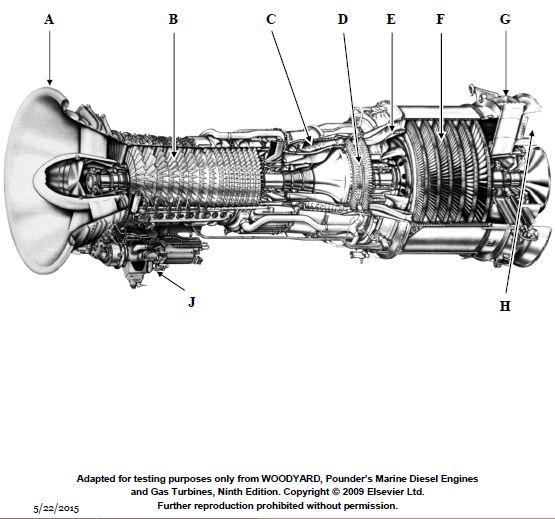 Illustration GT-0001
 The Brayton cycle, which governs gas turbine operation, relies on constant pressure combustion. In the combustion chamber, fuel is injected and burned at a relatively constant pressure, significantly increasing the gas temperature and volume before the high-energy gas expands through the turbine stages to produce mechanical work.
The term used to describe a gas turbine in which air drawn from the atmosphere passes through the engine only once is which of the following?
An open cycle gas turbine draws ambient air into the compressor, where it is pressurized, heated in the combustor, expanded through the turbine, and finally exhausted back into the atmosphere. This single-pass process is the standard configuration for most marine propulsion gas turbines due to its simplicity and power density.
A gas turbine that has a regenerator between the compression and combustion sections in which exhaust gas heat energy is added to the air charge is classified as what type of engine?
A semi-closed cycle engine incorporates a regenerator or recuperator to recover waste heat from the exhaust stream. By transferring this thermal energy to the compressor discharge air before it enters the combustion chamber, the engine improves its overall thermal efficiency by reducing the fuel required to reach target turbine temperatures.
The term used to describe a gas turbine in which the turbine exhaust passes through a cooler and back to the compressor inlet is which of the following?
Closed cycle gas turbines operate by recirculating the working fluid through a closed loop. The exhaust gas is cooled via a heat exchanger before returning to the compressor inlet. This configuration allows for the use of alternative working gases and prevents atmospheric contaminants from entering the engine's internal components.
In a regenerative or recuperative gas turbine cycle configuration, the heat of the turbine exhaust gas is used to do what?
Regenerators and recuperators utilize a heat exchanger to capture energy from the turbine exhaust. This heat is transferred to the high-pressure air exiting the compressor before it reaches the combustor. By preheating this air, the system reduces the fuel mass flow required to achieve the desired turbine inlet temperature.
Explore Other USCG Exam Modules
Complete your Coast Guard examination preparations across all 25 Deck, Engineering, and Radio ratings:
Frequently Asked Questions
Common questions regarding the USCG Gas Turbines examination, scoring benchmarks, and study strategies.
What is the USCG Gas Turbines examination?
What is the passing score for USCG GAS-TURB?
How many questions are in the USCG USCG GAS-TURB question bank on Bright Mariner?
Is access to the USCG GAS-TURB practice questions completely free?
Are these questions up to date with current 46 CFR and USCG NMC standards?
Question Discussion & Notes
0Have a doubt, memory trick, or exam update? Share your insights with fellow mariners.