
USCG Motor Plants & Auxiliary Boilers
Module Code: USCG MOTOR • 947 verified questions across 32 practice sets with 46 CFR and engineering rule citations. Completely free with zero paywalls.
USCG Motor Plants & Auxiliary Boilers Practice Sets
Select any module set below to begin timed examination practice with full answer analysis.
USCG MOTOR Practice Set 1
Full questions with verified 46 CFR rule explanations.
USCG MOTOR Practice Set 2
Full questions with verified 46 CFR rule explanations.
USCG MOTOR Practice Set 3
Full questions with verified 46 CFR rule explanations.
USCG MOTOR Practice Set 4
Full questions with verified 46 CFR rule explanations.
USCG MOTOR Practice Set 5
Full questions with verified 46 CFR rule explanations.
USCG MOTOR Practice Set 6
Full questions with verified 46 CFR rule explanations.
USCG MOTOR Practice Set 7
Full questions with verified 46 CFR rule explanations.
USCG MOTOR Practice Set 8
Full questions with verified 46 CFR rule explanations.
USCG MOTOR Practice Set 9
Full questions with verified 46 CFR rule explanations.
USCG MOTOR Practice Set 10
Full questions with verified 46 CFR rule explanations.
USCG MOTOR Practice Set 11
Full questions with verified 46 CFR rule explanations.
USCG MOTOR Practice Set 12
Full questions with verified 46 CFR rule explanations.
USCG MOTOR Practice Set 13
Full questions with verified 46 CFR rule explanations.
USCG MOTOR Practice Set 14
Full questions with verified 46 CFR rule explanations.
USCG MOTOR Practice Set 15
Full questions with verified 46 CFR rule explanations.
USCG MOTOR Practice Set 16
Full questions with verified 46 CFR rule explanations.
USCG MOTOR Practice Set 17
Full questions with verified 46 CFR rule explanations.
USCG MOTOR Practice Set 18
Full questions with verified 46 CFR rule explanations.
USCG MOTOR Practice Set 19
Full questions with verified 46 CFR rule explanations.
USCG MOTOR Practice Set 20
Full questions with verified 46 CFR rule explanations.
USCG MOTOR Practice Set 21
Full questions with verified 46 CFR rule explanations.
USCG MOTOR Practice Set 22
Full questions with verified 46 CFR rule explanations.
USCG MOTOR Practice Set 23
Full questions with verified 46 CFR rule explanations.
USCG MOTOR Practice Set 24
Full questions with verified 46 CFR rule explanations.
USCG MOTOR Practice Set 25
Full questions with verified 46 CFR rule explanations.
USCG MOTOR Practice Set 26
Full questions with verified 46 CFR rule explanations.
USCG MOTOR Practice Set 27
Full questions with verified 46 CFR rule explanations.
USCG MOTOR Practice Set 28
Full questions with verified 46 CFR rule explanations.
USCG MOTOR Practice Set 29
Full questions with verified 46 CFR rule explanations.
USCG MOTOR Practice Set 30
Full questions with verified 46 CFR rule explanations.
USCG MOTOR Practice Set 31
Full questions with verified 46 CFR rule explanations.
USCG MOTOR Practice Set 32
Full questions with verified 46 CFR rule explanations.
Sample USCG Motor Plants & Auxiliary Boilers Questions & Solutions
Preview authentic USCG NMC exam questions from this module with verified answers and rule citations.
The process of supplying a diesel engine cylinder with air at a pressure greater than atmospheric is called __________.
Supercharging forces induction air into the cylinder above atmospheric pressure using a compressor. Governed by marine diesel operating principles, this increases density, mass of trapped oxygen, and volumetric efficiency, enabling greater fuel mass combustion and higher power output per displacement.
Which of the listed types of superchargers will NOT have a volumetric capacity proportional to engine speed?
Exhaust gas turbochargers feature turbine and compressor speeds dictated by exhaust gas energy rather than direct mechanical linkage. Therefore, volumetric capacity varies with gas flow, unlike positive displacement blowers whose output is directly proportional to engine speed.
The relative air pressure in the inlet manifold of a turbocharged diesel engine is usually __________.
Efficient turbocharger operation requires scavenge air inlet pressure to exceed exhaust manifold pressure to establish a positive scavenging pressure differential across the cylinder. This ensures complete expulsion of exhaust gases and thorough charging of fresh air.
Why will a turbocharged diesel engine produce black smoke if excessive additional load is applied too quickly?
Applying sudden heavy loads causes immediate fuel injection increase, but turbocharger rotor inertia creates a rotational time lag. The temporary air-fuel deficit produces incomplete combustion, carbon particulates, and characteristic black smoke until turbine speed catches up.
The device shown in the illustration is commonly used to __________. Illustration MO-0080
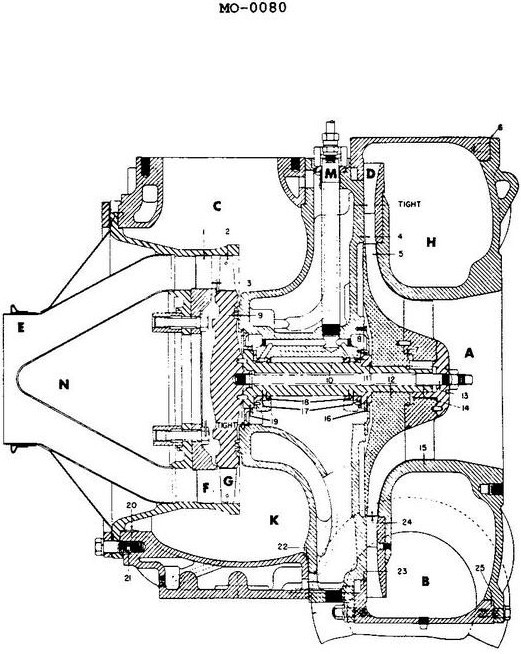 Illustration MO-0080
 Exhaust gas turbochargers harness waste thermal and kinetic energy from exhaust gases through a turbine wheel driving an air compressor impeller. This fulfills the primary method of marine diesel supercharging, aligning with 46 CFR Subchapter F machinery design principles.
The power consumed during the scavenging process of a diesel engine is known as the __________.
Pumping loss represents the negative work performed by the piston during scavenging and exhaust strokes to push gases out and draw fresh air in. Per marine diesel operating principles, this pressure differential across the cylinder requires energy consumption from the crankshaft.
Explore Other USCG Exam Modules
Complete your Coast Guard examination preparations across all 25 Deck, Engineering, and Radio ratings:
Frequently Asked Questions
Common questions regarding the USCG Motor Plants & Auxiliary Boilers examination, scoring benchmarks, and study strategies.
What is the USCG Motor Plants & Auxiliary Boilers examination?
What is the passing score for USCG MOTOR?
How many questions are in the USCG USCG MOTOR question bank on Bright Mariner?
Is access to the USCG MOTOR practice questions completely free?
Are these questions up to date with current 46 CFR and USCG NMC standards?
Question Discussion & Notes
0Have a doubt, memory trick, or exam update? Share your insights with fellow mariners.